

2026.03.10
This article examines the position of Iranian saffron in global markets and the challenges faced along the export chain. In addition, to facilitate the export process, the services of Marjaan Khatam Food Laboratory recognized as the first and most reputable food laboratory in the country for saffron safety control are introduced.
Introduction
The cultivation history of saffron (Crocus sativus) dates back approximately 3500 years, to the era of the Sumerians and Babylonians. Historical and botanical studies suggest that the original homeland of saffron was likely the Mediterranean coasts of Asia Minor or Mesopotamia. However, other regions such as Southeast Asia, Central Asia, the Indian subcontinent, Iran, ancient Greece, and the island of Crete have also been proposed as potential origins of this valuable plant.
Saffron is known worldwide as “Red Gold” due to its medicinal properties, unique aroma and flavor, and its highly intricate and costly production process, which involves manually harvesting the dried stigmas of saffron flowers. This product is not only one of the most expensive spices in the world but also holds a distinguished position in international trade as one of the most important export commodities.
Iran’s Share of Global Saffron Production and Export
With approximately 92–95% of total global saffron production, Iran is recognized as the world’s largest producer of this crop. However, a significant portion of saffron produced in Iran does not appear in official international trade statistics. Part of the production is consumed domestically and is therefore not included in global export figures. Additionally, a portion of Iranian saffron leaves the country through informal or unofficial routes, the details of which will be explained in the section “Challenges of Saffron Export.”
The combination of these two factors creates a notable gap between Iran’s actual saffron production volume and the amount recorded in global export statistics, resulting in an incomplete representation of Iran’s true role in international markets.
- Status of Iran’s Saffron Exports in 2024 (1403 in the Iranian calendar)
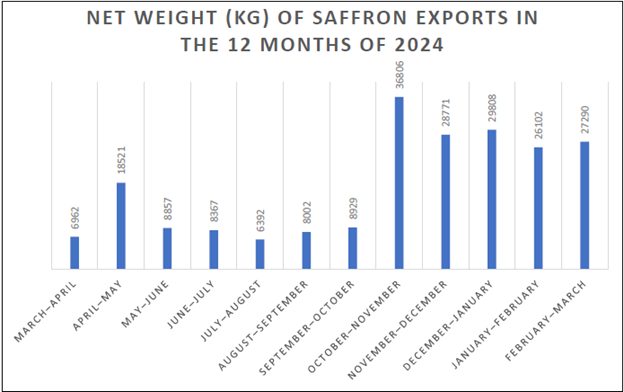
According to published data, the total volume of Iran’s saffron exports in the past year (2024) amounted to 214807 kilograms.
The monthly export quantities for all 12 months of the previous year are illustrated in the chart below:
- Status of Iran’s Saffron Exports in 2025 (1404 in the Iranian calendar)
According to the latest available data, Iran’s saffron exports in the first seven months of the current year (2025) amounted to 116708 kilograms.
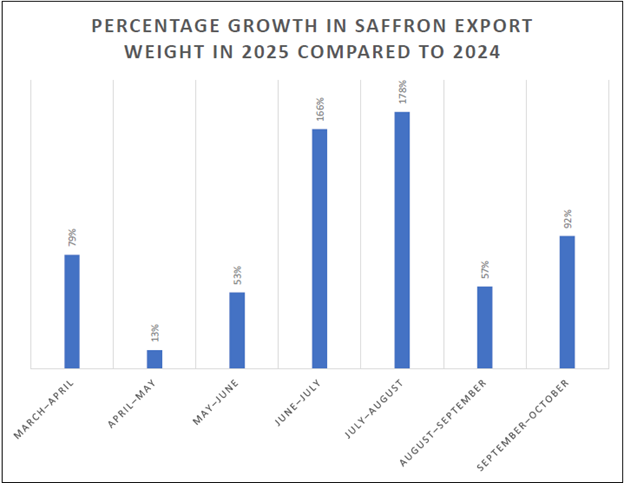
The export volumes for the first seven months of 2025, alongside the corresponding seven-month period in 2024, are shown in the following chart:
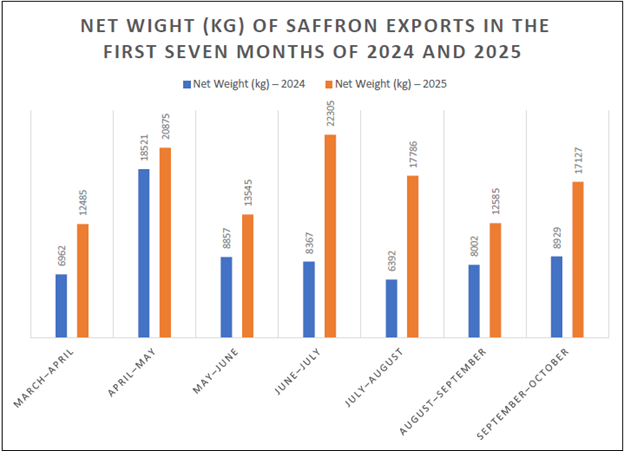
As shown in the chart above, Iran’s saffron exports in 2025 are higher than in 2024. A comparison of the country’s export performance in these two years indicates a 77% increase.
Challenges of Saffron Export
Despite Iran’s substantial capacity for saffron production and the strong global demand for this commodity, its export faces several obstacles and constraints. These challenges not only hinder access to certain markets but also increase operational costs and business risks for exporters.
As a result, exporters encounter multiple difficulties, the most significant of which include:
- Impact of Sanctions and Trade Tariffs on Iran’s Saffron Exports
Under current conditions, economic sanctions and the tariffs imposed by certain countries on Iranian goods represent major barriers to saffron export. A tariff is essentially a type of tax or additional fee charged by the importing country on goods entering its market.
In many key destinations, the tariff rates applied to Iranian saffron are significantly higher than those imposed on competing exporters such as Spain or Afghanistan. This discrepancy increases the final retail price of Iranian saffron in the destination market, reducing its competitiveness and, in some cases, making exports economically unjustifiable for Iranian traders.
- Bulk Export of Saffron
Generally, products sold in small, branded retail packages command higher prices than the same products sold in bulk. Therefore, bulk export not only reduces potential economic profit but also shifts the commercial added value and brand recognition to the countries that purchase Iranian saffron, repackage it, and re-export it under their own brands.
Despite this disadvantage, a considerable portion of Iran’s saffron continues to be exported in bulk and without a defined commercial identity. The main reason is that bulk export is cheaper for exporters, as it eliminates packaging costs and usually incurs lower taxes and customs duties. Moreover, many foreign buyers of Iranian saffron are themselves exporters; thus, they prefer to purchase the product in bulk, then package and market it internationally under their own labels.
According to documented statistics, Iran’s total saffron exports to Europe last year amounted to approximately 44159 kilograms, with Spain accounting for the largest share about 32648 kilograms.
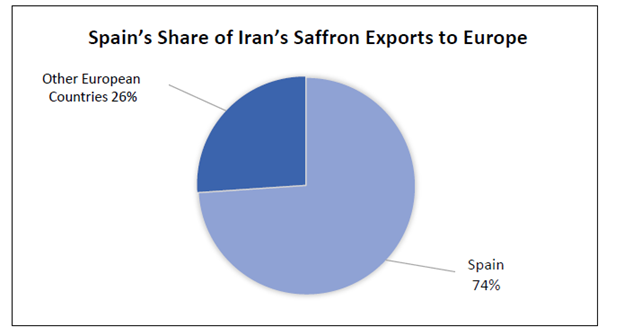
As illustrated in the chart, approximately 74% of all saffron exported from Iran to Europe is shipped to Spain. In other words, Spain holds the largest share of the European market for Iranian saffron, while only about 26% is exported to other European countries.
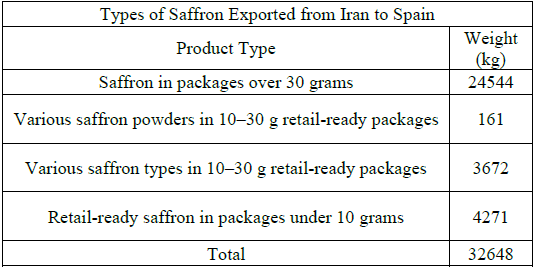
According to export statistics, out of the 32648 kilograms of saffron exported to Spain, 24544 kilograms were shipped in large packages (over 30 grams). The details of the packaging types for saffron exported to Spain are presented in the table below:
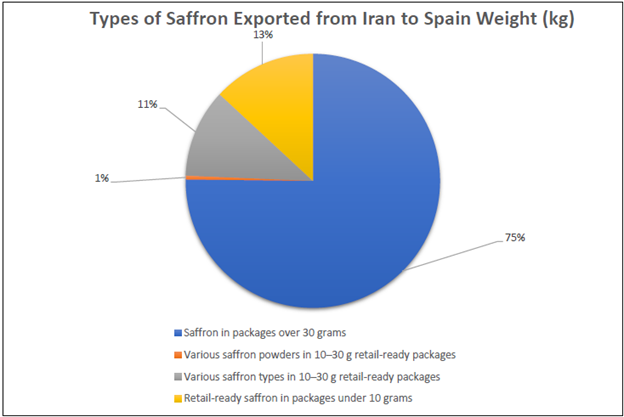
The chart below shows that approximately 75% of the saffron exported to Spain is shipped in large, industrial packages weighing more than 30 grams. In contrast, the volume of saffron exported in smaller packages those under 30 grams, which are primarily intended for retail markets is very limited and represents only a minor share of Iran’s total saffron exports to Spain.
Although Spain has only a limited domestic production of saffron, it is considered one of the world’s major saffron exporters. A significant portion of the saffron Spain exports is originally imported from Iran; Spain then repackages and rebrands this saffron under Spanish labels and distributes it to global markets. As a result, many consumers in destination countries recognize saffron as a Spanish product and remain unaware of its true Iranian origin.
- Informal Saffron Exports and Their Consequences
In recent years, rising costs, increasing administrative complexity, and various restrictions along the export chain have pushed some stakeholders toward informal export practices.
The most common informal channels of saffron outflow include:
- Smuggling, which involves illegally transporting saffron out of the country.
- Carrying and selling small quantities of saffron by travelers during international trips, commonly referred to as suitcase exports, which is legal in limited amounts.
Saffron exported through informal routes is not recorded in official foreign trade statistics; therefore, there is no accurate estimate of its actual volume. This situation lowers Iran’s position in global saffron exporter rankings, which are based solely on officially recorded export figures.
Furthermore, informal or illegal routes typically lack the necessary quality and safety controls. Consequently, saffron that has not undergone standard testing or obtained required certifications may enter international markets. This increases the risk of low-quality or non-compliant products being associated with Iran and ultimately harms the credibility and commercial value of Iranian saffron worldwide.
- Currency Fluctuations and the Foreign Exchange Commitment Regulation
Severe volatility in currency exchange rates and repeated price surges in recent years have made foreign exchange management one of the government’s central challenges. Unstable exchange rates impede long-term planning for businesses and make the inflow of export revenues unpredictable.
To regulate foreign exchange flows and prevent capital flight, the government enforces the Foreign Exchange Commitment Regulation, which requires exporters to repatriate their export earnings through monitored channels.
This regulation, implemented since 2017 (1397 in the Iranian calendar ) and still in force, obligates exporters to return their foreign currency revenues within a specified timeframe through designated platforms most notably the NIMA exchange system. The goal is to ensure the availability of foreign currency for imports and prevent loss of national financial resources.
However, this policy has had significant implications for saffron exporters. The large discrepancy between the NIMA exchange rate and the free-market rate often makes it economically unviable for exporters to sell their currency earnings through NIMA. As a result, some exporters are unable to fulfill their mandated commitments and are consequently listed as debtors by the Central Bank. In addition, the Tax Organization imposes penalties for each year in which the currency is not repatriated.
These cumulative pressures have forced many exporters to lose access to their commercial cards and gradually withdraw from the formal export market.
According to available data, in 2017 (1396 in the Iranian calendar), Iran exported approximately 325 tons of saffron to seven countries. By contrast, saffron exports in 2024 (1403 in the Iranian calendar ) decreased to 214 tons, even though the number of export destinations expanded to 71 countries. Given this substantial diversification of markets, it would have been reasonable to expect export volumes to increase from 325 tons to nearly 500 tons during this period. Instead, the declining trend indicates the presence of structural weaknesses and persistent challenges within Iran’s saffron export supply chain.
Quality and Safety Control Tests for Saffron
Compliance with standardized testing requirements is essential for saffron exports and is recognized as an internationally valid criterion that can significantly enhance the product’s value in global markets. According to saffron standards, a set of tests is performed to assess quality characteristics and determine product grading. In addition, a separate group of tests evaluates safety parameters to ensure compliance with food safety regulations and confirm the product’s suitability for consumption.
Saffron Quality Indicators and Analytical Tests
To determine saffron quality categories including Premium, Grade 1, Grade 2, Grade 3, and Grade 4 it is necessary to conduct both sensory evaluations (such as aroma, taste, and color) and a series of physicochemical analyses. These tests provide precise information on key saffron compounds and purity levels, offering a more scientific basis for quality assessment.
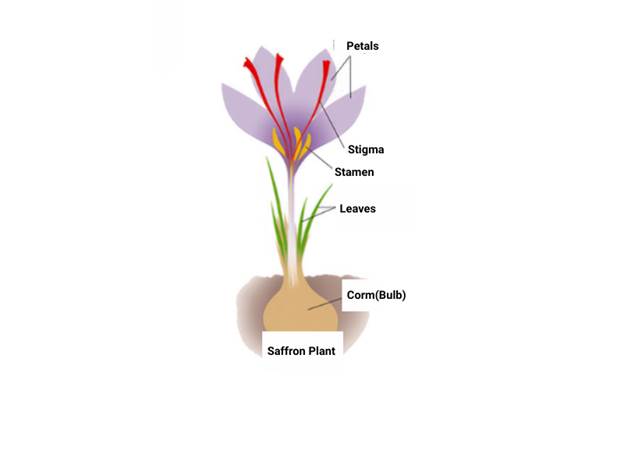
To better understand the purpose and nature of the tests described later, it is important to begin with the structure of the saffron plant and its floral components. As shown in the image, saffron consists of several parts including the corm (bulb), leaves, stem, petals, stigma, and stamen.
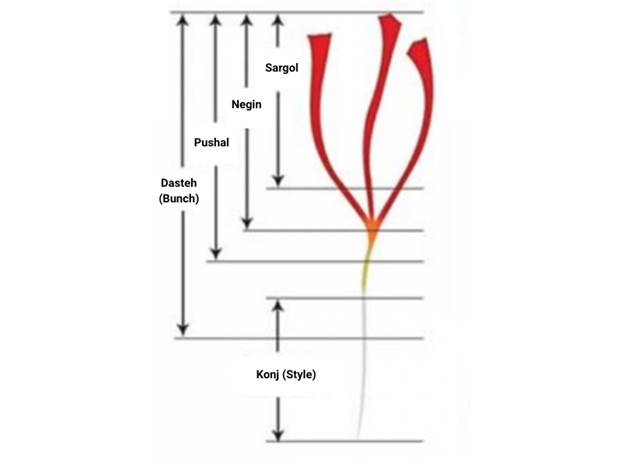
The valuable and commercially significant part of the saffron plant is the stigma, which is separated, dried, and processed before being offered as the final product. As shown in the image, saffron stigmas are classified into five categories: Sargol, Negin, Pushal, Dasteh (Bunch), and Konj (also known as Style).
According to the requirements of the Iranian National Standard for saffron, different types of saffron are categorized into several main groups based on their appearance and processing method:
- Filament Saffron
Filament saffron consists of the dried stigmas of the saffron flower, which may be dried in full form, including the red part and a portion of the style (the whitish end of the stigma). According to the standard, the presence of a small amount of white style is permitted. This product corresponds to the common saffron threads available in the market.
- Cut Filament Saffron
In cut filament saffron, only the red portion of the stigma is used, and the style (white part) is completely removed. This type of saffron is generally recognized as a product with higher purity.
- Saffron Powder
Saffron powder is produced by grinding or milling dried saffron (either filament or cut filament) into fine, uniform particles free from coarse fragments.
The most important physicochemical tests are described below:
- Extraneous matter related to the environment (unacceptable substances):This includes any elements not related to the saffron product, such as small stones, soil, plastic fragments, live or dead insects and mites along with their body parts, droppings, and rodent or bird hair/feathers. Clearly, the lower the amount of these substances, the fewer impurities the product contains, resulting in a higher-quality and more desirable saffron.


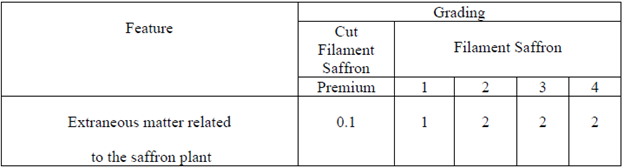
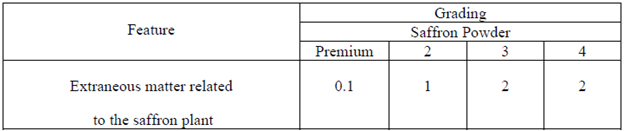
- Extraneous matter related to the saffron plant: This refers to parts of the saffron flower that are not considered part of the red stigma threads, such as the style, stamen, petals, and other floral components. The presence of these elements reduces the overall quality of the product.
- Ash: Ash content is one of the key criteria for assessing the purity and quality of saffron. When saffron is burned in the laboratory, its organic components (the plant material) are destroyed, while the mineral substances remain as ash. These may include soil particles, sand, dust, mineral salts, or residues of fertilizers and environmental contaminants. Therefore, a high ash content indicates that the saffron is not pure and contains mineral impurities, which ultimately reduces the quality and commercial value of the product.
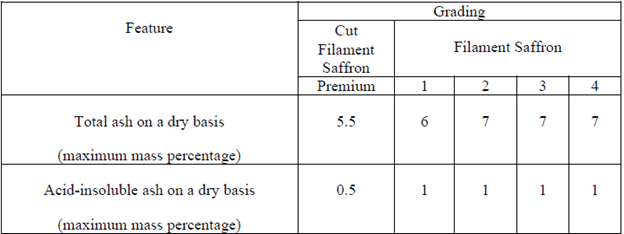
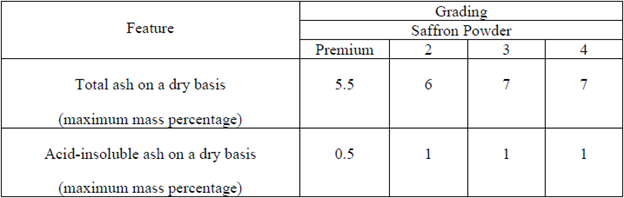
Note: Total ash represents the total mineral content remaining after combustion, while acid-insoluble ash refers to the portion of this ash that does not dissolve in acid.
The valuable part of saffronthe stigma contains several key compounds, including crocins, safranal, and picrocrocin, each of which plays an important role in determining saffron quality.
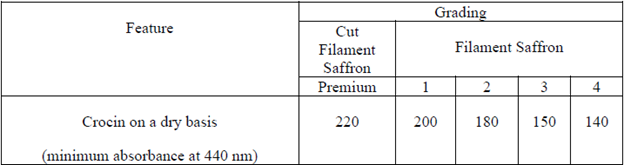
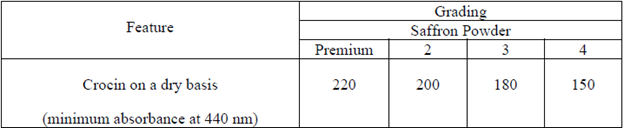
- Crocin: the main compound responsible for saffron’s coloring power
Crocin is one of the most important metabolites in saffron and is recognized as the primary compound responsible for the red color of the stigmas. It is highly water-soluble and plays a decisive role in saffron’s coloring strength. Studies have shown that the higher the crocin content, the greater the coloring power of the product, which is an indicator of superior quality.
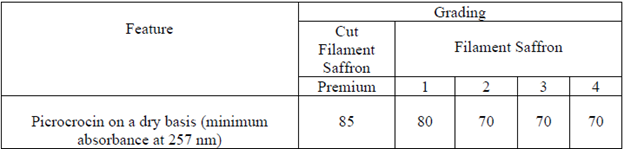
- Picrocrocin: the key compound responsible for saffron’s flavor
Picrocrocin is one of the main flavor-forming compounds in saffron. Its concentration is higher in fresh stigmas but decreases during the drying process. Picrocrocin is also considered the biochemical precursor of safranal.

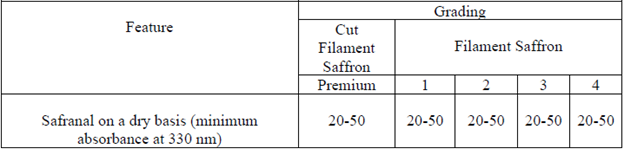
- Safranal: the key compound responsible for saffron’s aroma
Safranal is recognized as the primary compound responsible for saffron’s characteristic aroma. It naturally exists in very small amounts in fresh saffron, but its concentration increases during the drying process as a result of picrocrocin degradation. Consequently, the aroma of dried saffron is significantly stronger than that of fresh stigmas, highlighting the importance of proper processing in maintaining saffron’s aromatic quality.

Safety Indicators and Tests for Saffron
- Measurement of Chemical Pesticide Residues
In saffron cultivation, as in other agricultural products, there is always a possibility of contamination by pests and plant diseases. Pests can damage the plant, reduce its productivity, and consequently lower the harvestable yield. Because the saffron plant grows close to the ground and lacks tall stems, weeds can easily overshadow it and block the sunlight needed for proper growth. Weeds not only affect saffron growth but may also serve as a habitat for pests and plant pathogens.
For these reasons, farmers commonly use chemical pesticides to control weeds and pests. However, residues of these chemicals may remain on the final product and pose health risks such as neurological disorders, liver and kidney problems, carcinogenic effects, and more. To prevent such risks to consumers, Maximum Residue Limits (MRLs) have been established for saffron.
Maximum residue limits for chemical pesticides in saffron are defined according to European Union standards
- Microbiological Tests
Since saffron flowers grow very close to the soil surface, there is a possibility that microorganisms present in soil, water, or fertilizers may contaminate the crop. Additionally, during harvesting, stigma separation, and initial processing, saffron may come into contact with hands, tools, or unsanitary environments, increasing the risk of microbial contamination.
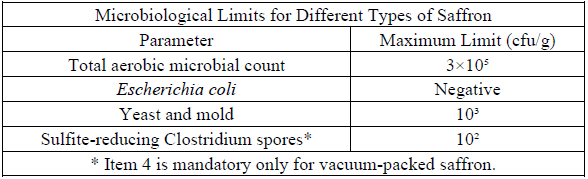
Although these contaminants may be reduced during drying and storage, microbiological testing is included in the standards to ensure safety. Such tests typically include total microbial count, Escherichia coli, yeasts and molds, and other relevant indicators. Microbial control is essential not only for consumer safety but also for maintaining the export eligibility of saffron.
- Measurement of Heavy Metals
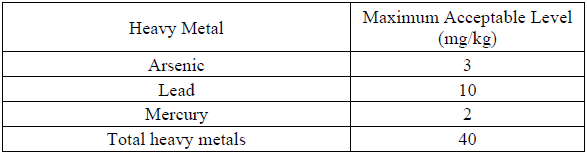
The soil and water in saffron cultivation areas may become contaminated with heavy metals due to various factors, including pollution from traffic and vehicle emissions, excessive use of certain chemical fertilizers, industrial activities, and contamination of water sources. When present in the environment, these elements can be absorbed by the plant and accumulate in the stigmas.
Excessive accumulation of heavy metals poses serious health risks to consumers, including neurological damage, kidney and liver dysfunction, carcinogenic effects, and hematological disorders. Therefore, standards have been established to define the Maximum Residue Limits (MRLs) for heavy metals in saffron, including arsenic, lead, mercury, and others. These limits are presented in the following table:
Introducing Marjaan Khatam Laboratory and Its Services for Saffron
Marjaan Khatam Food Laboratory, a collaborator of the National Standards Organization of Iran, the Food and Drug Administration, and the Veterinary Organization, holds the international accreditation ISO/IEC 17025 from the Iranian National Accreditation Center (NACI). With professional experts, advanced analytical equipment, and modern laboratory facilities across four domestic branches Tehran, Khorramshahr, Bandar Imam Khomeini, and Kerman and one international branch in Russia, the laboratory is fully equipped to provide comprehensive testing services.
In the field of saffron export, Marjaan Khatam Food Laboratory strives to support exporters by delivering reliable and internationally recognized analytical services. The required tests for saffron vary depending on the regulations of each destination country. These services include:
- Pesticide Residue Testing
Accurate measurement of pesticide residues in saffron is performed using advanced instruments such as GC-MS/MS and LC-MS/MS, which enable the detection of pesticides even at very low concentrations an essential requirement for export compliance.
To view the list of pesticide residues measurable in saffron by Marjaan Khatam Laboratory, along with the minimum quantifiable level (LOQ) achievable by GC-MS/MS, see the link below:
https://marjaangroup.com/ckfinder/userfiles/files/LOQs%20for%20Saffron%20matrix%20by%20GC-MSMS.pdf
To view the LOQ list for pesticide residues measured using LC-MS/MS, refer to:
https://marjaangroup.com/ckfinder/userfiles/files/LOQs%20for%20saffron%20by%20LC-MSMS.pdf
- Heavy Metal Analysis
Marjaan Khatam Food Laboratory performs heavy metal testing using highly sensitive analytical techniques, such as Atomic Absorption Spectroscopy (AAS), capable of detecting and quantifying trace levels of heavy metals in saffron samples.
For detailed information on heavy metal standards and the list of heavy metals measurable by Marjaan Khatam Laboratory, visit:
https://marjaangroup.com/service/%D9%81%D9%84%D8%B2%D8%A7%D8%AA-%D8%B3%D9%86%DA%AF%DB%8C%D9%86
- Microbiological Testing
Marjaan Khatam Food Laboratory can accurately assess saffron for microbiological parameters using methods such as microbial culture, colony counting, and rapid tests for pathogen detection.
For detailed information on microbiological tests offered by Marjaan Khatam Laboratory, see: