

2026.03.10

With the continuous increase in population, the growing human need for food and efforts to protect agricultural products against pests, diseases and other contaminations, chemical pesticides and insecticides are used worldwide. Pesticides are synthetic or natural compounds that are used in agriculture to control pests, weeds and plant diseases. In addition to causing environmental pollution and reducing biodiversity (by destroying beneficial insects such as honeybees, etc.), they remain in agricultural products and, if their levels exceed the permissible limit (MRL), they can pose serious risks to human health. MRL refers to the maximum allowable concentration of chemical pesticide residues in agricultural products, which is usually expressed in milligrams per kilogram (ppm) and is recognized as a standard for international trade and food safety.
The World Health Organization (WHO) estimates that nearly 250,000 deaths occur annually worldwide due to poisoning, of which pesticides alone are responsible for 150,000 deaths. According to a report by the Pesticide Action Network (PAN), 385 million people worldwide suffer from severe chemical pesticide poisoning each year, whereas this number was about 25 million around 1990.
In general, most agricultural products that are exposed to pesticides and are marketed shortly after spraying, without observing the so-called pre-harvest interval, contain high levels of pesticide residues, especially greenhouse products. The pre-harvest interval is the minimum time between the last pesticide application and harvesting, which must be observed so that pesticide residues in the product degrade and their levels on the surface of fruits and vegetables decrease. Observing this interval is particularly important for agricultural products that are consumed fresh. Unfortunately, in many cases these products enter the market and are sold before the pre-harvest interval has elapsed.
It should also be noted that if the amount of pesticide used exceeds the level recommended by the manufacturing company, even with observance of the pre-harvest interval, the pesticide residues will be higher than the permissible limit. Another important point is the correct application of pesticides in accordance with the manufacturers’ instructions; if the sprayer is not calibrated, the pesticide will not be applied in the prescribed amount and even after the pre-harvest interval has passed, high levels of pesticides may remain in agricultural products, or conversely, the application may not be effective. In addition to all these issues, some pesticides have been banned by certain countries and organizations but are unfortunately still used in Iran. For example, chlorpyrifos, which has not been approved by the European Union and has also been banned in Iran (included in the list of pesticides removed by the Plant Protection Organization) and despite the ban on diazinon by both the European Union and Iran (included in the list of pesticides removed by the Plant Protection Organization), it is still used in Iran.
Toxicity of Pesticides:
The degree of toxicity of pesticides is determined by the LD₅₀ index. LD₅₀ refers to a specific amount of a pesticide that, on average, causes the death of approximately 50% of a population of laboratory animals and the route of exposure (oral and dermal) must also be specified. The higher the LD₅₀ value, the lower the toxicity of the substance. For example, LD₅₀ values for liquid pesticides are as follows.
Pesticides with an LD₅₀ of less than 200 mg/kg are extremely toxic pesticides.
Pesticides with an LD₅₀ between 200 and 2000 mg/kg are pesticides with moderate toxicity.
Pesticides with an LD₅₀ between 2000 and 3000 mg/kg are pesticides with low toxicity.
Pesticides with an LD₅₀ greater than 3000 mg/kg are pesticides without acute toxicity.
Classification of Pesticides:
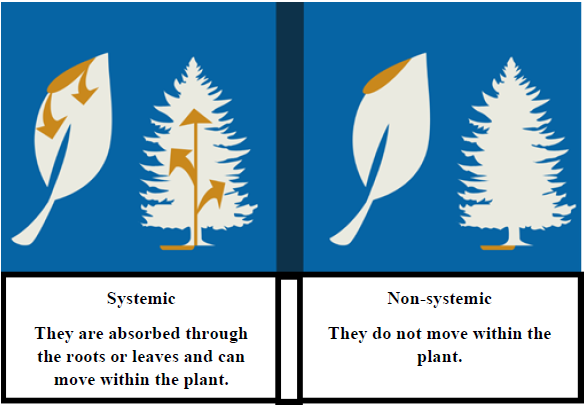
Classification of pesticides based on their mode of movement within the plant:
Non-systemic pesticides: These pesticides are lipophilic and are absorbed into the waxy layer of plants, remaining only on the external parts of the plant and not moving within the plant. Chlorpyrifos is a non-systemic insecticide and this pesticide eliminates stem-boring pests and provides appropriate effectiveness. Cypermethrin is another type of insecticidal pesticide, belongs to the non-systemic group and is used to eliminate chewing and sucking pests and has high residual activity.
Systemic pesticides: Systemic pesticides are absorbed through one part of the plant, then distributed throughout all parts of the plant and lead to pest control. For this reason, systemic pesticides cannot be easily removed from plants compared to non-systemic pesticides. Acetamiprid and imidacloprid are examples of systemic pesticides.
Classification Based on the Mode of Penetration:
Stomach (ingestion) pesticides: These are compounds that enter the body of pests through the digestive system and cause death by disrupting tissues and organs (such as abamectin and permethrin).
Contact pesticides: These are compounds that enter the body of the pest through the skin and cause poisoning and death of the insect (such as malathion and gusathion).
Fumigant pesticides: These are compounds that, under normal conditions, become gaseous and enter the respiratory system of pests through respiratory openings, replacing oxygen and causing suffocation of the pests (such as aluminum phosphide and hydrogen cyanide).
Classification of Pesticides Based on Chemical Structure and Type of Chemical Compound:
In addition, pesticides are classified based on their chemical structure into two categories: inorganic (carbon-free) and organic (carbon-containing). Inorganic pesticides are divided into two groups: natural (such as sulfur) and synthetic (such as arsenic-based pesticides). Organic pesticides are also divided into two groups: natural (such as azadirachtin) and synthetic (such as organophosphates, organochlorines, carbamates, triazines, phenoxy compounds, pyrethroids and neonicotinoids).
- Organophosphate pesticides: This term refers to all pesticides that contain phosphorus in their chemical structure, with phosphoric acid being their main source. Most organophosphate pesticides are insecticides and the reason for their widespread use is the high sensitivity of insects to these compounds. This group includes pesticides with contact, stomach, fumigant and systemic modes of action. Organophosphate pesticides can reduce insulin production and have the ability to damage DNA. Maternal sensitivity to organophosphates can lead to shortened pregnancy duration and developmental disorders in infants. The most well-known pesticides in this group include malathion, diazinon and dimethoate.
- Organochlorine pesticides: These pesticides have been widely used in various fields against many types of insects; however, at present, organochlorine pesticides are used less frequently due to their high persistence in the environment. These compounds are insoluble in water but soluble in fats; therefore, they can easily accumulate in the fatty tissues of humans and animals. For example, a cow that has previously been exposed to contamination may have this contamination present in the fat of its milk and humans may become contaminated by consuming this milk.
DDT is a common type of organochlorine pesticide and its uncontrolled use has caused numerous environmental and health problems and can lead to various types of cancer. Due to its long-term effects and persistence in the food chain, the use of DDT has been banned almost worldwide; however, it is still illegally used in many countries, especially in developing countries. Endosulfan, dieldrin, heptachlor, methoxychlor and dicofol are other organochlorine pesticides. Adverse effects of organochlorine pesticides include endocrine abnormalities and effects on fetal development. - Carbamate pesticides: Carbofuran and aldicarb are groups of carbamates with widespread application and were introduced later than organochlorine and organophosphate groups. Carbamates include insecticides, fungicides and herbicides and most of them have low environmental persistence. In terms of toxicity, this group includes pesticides ranging from low to very high toxicity. These pesticides can also affect human health by disrupting endocrine function, causing neurobehavioral diseases and increasing the risk of dementia.
- Triazine pesticides: Pesticides in this group, such as atrazine, are all herbicides and are mostly absorbed through the roots and act via a systemic mechanism. Triazines are among the persistent pesticides that can remain in soil for long periods. Triazine herbicides may also be involved in the development of diseases such as breast cancer.
- Phenoxy pesticides: Phenoxy pesticides are widely used to control broadleaf weeds in fields of cereal crops such as wheat. This group of pesticides may also be involved in the development of cancer and can cause congenital defects in children.
- Pyrethroid pesticides: Pyrethroids are a group of synthetic organic insecticides that are derived from pyrethrins (plant extracts from chrysanthemum flowers). Since the 1980s, pyrethroids have been widely used worldwide due to their high effectiveness and relatively low toxicity compared to other insecticides. Cypermethrin and deltamethrin belong to this group. Many household insecticides contain certain pyrethroids and are effective in controlling insect-borne diseases such as malaria. Compared to traditional pesticides, pyrethroids have a lower potential to contaminate the environment; however, they can enter living organisms through the food chain. Due to their lipophilic nature, the elimination of pyrethroids after entering living organisms is difficult. Long-term exposure to pyrethroids can cause chronic diseases and exert toxic effects on the nervous, immune, cardiovascular and genetic systems of living organisms and may also lead to carcinogenicity.
- Neonicotinoid pesticides: These pesticides are a group of chemicals used as insecticides by exerting negative effects on the nervous system of insects and there is concern that neonicotinoids may also affect other organisms, including humans. Acetamiprid, imidacloprid and thiamethoxam are examples of these pesticides. Acute poisoning with neonicotinoids in humans leads to respiratory, cardiovascular and neurological symptoms.
Classification of Pesticides Based on Generations:
Due to the hazards of chemical pesticides and in order to reduce their negative effects on humans and the environment, different generations of pesticides have emerged.
- First-generation insecticides include inorganic compounds such as arsenic.
- Second-generation pesticides include the expanded use of organochlorines, organophosphates, carbamates and synthetic pyrethroids. In this generation, the pesticide DDT emerged.
- Third-generation pesticides are known as bio-based or biorational pesticides and are essentially biological materials used to control specific pests without affecting non-target organisms. They include hormones, enzymes, pheromones, insect growth regulators (IGRs), viruses, bacteria, fungi and insect-pathogenic nematodes.
- The introduction of fourth-generation pesticides, known as biological pesticides based on biotechnology, likely began with the design and production of pest-resistant plants through gene transfer and genetic modification. In recent years, the fourth generation, based on gene transfer technology, has been developed, in which toxin-producing genes from the bacterium Bacillus thuringiensis (Bt) are transferred to plants. As a result, the plant gains the ability to produce this type of protein to eliminate insects. However, since many insects have developed resistance to this bacterium, scientists have invested scientific efforts alongside this approach in other compounds as well.
The issue of controlling pesticide residues in food products, in addition to its harmful effects on humans, causes enormous economic losses especially for exporters and leads to the return of export shipments. Moreover, it damages the country’s reputation in the field of exports.
Maximum Residue Limits (MRLs)
To find out the maximum residue limits (MRLs) of pesticide residues in products in Iran, see the link below:
Plant Protection Research Institute of Iran
To find out the maximum residue limits (MRLs) of pesticide residues in the European Union, see the link below:
Official website of the European Union
Also, see the list of banned pesticides in Iran here.
And the list of banned pesticides in the European Union here.
In addition, exporters need to consider the laws and requirements of the destination country before sending export shipments. To ensure compliance with the maximum residue limits and measurement of pesticide residues, they should have the products tested in a reputable food laboratory with a high detection limit, according to European standards, before exporting to avoid issues in the destination country. To find out the maximum residue limits, visit the website of Marjaan Khatam Laboratory.